
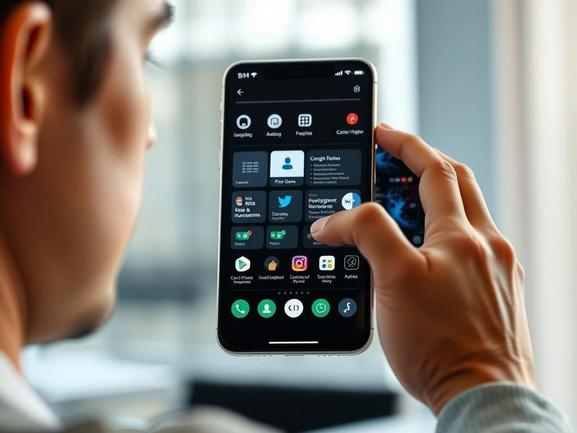
In the rapidly evolving landscape of mobile technology, where the app store has reigned supreme for over a decade, a provocative vision is emerging, challenging the very foundation of how we interact with our smartphones. The CEO of Nothing, a relatively new but notable player in the tech space, recently articulated a view that is both radical and, upon closer examination, perhaps not entirely far-fetched. He posits that the era of juggling dozens, if not hundreds, of individual applications could eventually draw to a close, replaced by a singular, all-encompassing intelligent operating system. This isn’t merely an evolution; it’s a potential paradigm shift that could redefine the smartphone experience as we know it.
At the heart of this vision is the idea that the operating system itself transcends its current role as a mere platform and transforms into the primary, perhaps *only*, interface the user needs. Imagine a system so deeply integrated with your personal context – your schedule, location, communication patterns, and preferences – that it anticipates your needs and handles tasks proactively, without requiring you to open a specific app. The CEO describes this future state where the “entire phone will only have one app—and that will be the OS.” This isn’t just about smarter notifications or better widgets; it’s about the OS becoming a dynamic, personalized agent that understands *you* and optimizes itself accordingly. It moves beyond data-driven personalization to true automation, where the system doesn’t just suggest but *acts* on your behalf, based on its comprehensive understanding of your situation, time, and intentions.
What enables this potential leap? The answer, according to proponents of this idea, lies squarely with the explosive advancements in generative AI. Current AI models are already demonstrating an impressive capability to understand natural language, process complex queries, and generate creative content. As these models become more sophisticated, integrated, and context-aware, their ability to perform tasks that were once the exclusive domain of dedicated apps grows exponentially. We’re already seeing early examples, such as users attempting to replace traditional search engines with AI chatbots or leveraging AI for complex writing or coding tasks. In this hypothesized future, a highly advanced, on-device or tightly integrated cloud AI wouldn’t just help you draft an email; it would know who you need to email, about what, at what time, based on your calendar and recent interactions, and might even draft the core message automatically, presenting it to you for review. This suggests a world where AI gradually subsumes the functions of numerous apps, making them secondary or even obsolete interfaces.
Acknowledging the revolutionary nature of this concept, the Nothing CEO is realistic about the timeline. He estimates this transition could take seven to ten years, a timeframe that recognizes the significant technical hurdles and, more importantly, the deeply ingrained user habits. We live in an app-centric world; opening a specific app for a specific task is second nature for billions of smartphone users. This comfort and familiarity create inertia. Convincing people to abandon their carefully curated app libraries for a single, all-powerful OS interface is a monumental challenge. Furthermore, the infrastructure and AI capabilities required to make a single OS truly capable of handling the vast diversity of tasks currently covered by millions of apps across entertainment, productivity, communication, utilities, and more, are still under development. It’s a future that requires not just technological readiness but also a fundamental shift in user perception and behaviour.
Reflecting on this vision, several fascinating implications arise. For one, it represents a potential challenge to established tech giants like Apple, whose business model is heavily reliant on the App Store ecosystem. A world where apps are marginalized would necessitate a dramatic pivot. While the critique that Apple is “no longer creative” is subjective and debatable given their continued innovation in hardware and integrated services, this single-OS future certainly forces contemplation on whether the current app-grid paradigm has reached its evolutionary peak. For developers, it presents both a threat and an opportunity – a move away from building standalone apps towards contributing features and intelligence to a core OS platform. For users, the promise is simplicity and efficiency, but the risk lies in centralization and potential vendor lock-in. Could a single OS truly cater to the infinite variability of human needs and preferences as effectively as a diverse marketplace of specialized apps? This radical idea, while perhaps not fully convincing everyone today, serves as a crucial thought experiment, pushing the boundaries of what we imagine the future of mobile computing could be, driven by the relentless march of artificial intelligence.