
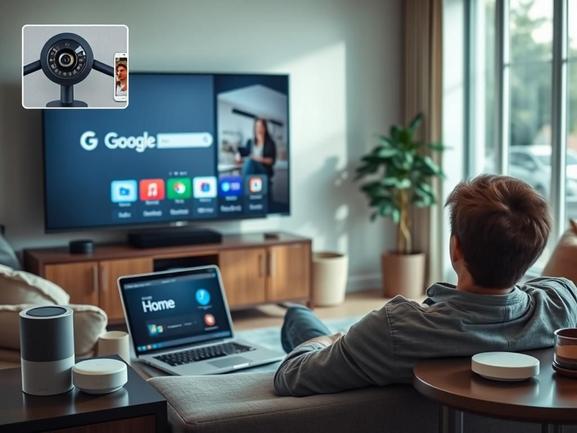
Google continues to refine and expand its smart home ecosystem, bringing new levels of control, convenience, and integration across various platforms and devices. Recent announcements highlight a strategic push towards making the Google Home experience more accessible via the web, smarter with the integration of AI capabilities like Gemini, and more visually integrated, particularly for users leveraging Google TV. These updates signal a maturing platform, aiming to provide a more unified and intuitive experience, whether you’re managing your devices from a desktop browser, interacting via voice, or relaxing in front of your television.
One of the most significant developments is the imminent expansion of the Google Home web app available at home.google.com. Previously offering limited functionality, the platform is slated to receive substantially more controls. Users will soon be able to adjust lights, set temperatures, and even unlock doors directly from their web browsers. This move is particularly noteworthy as it frees users from reliance solely on the mobile app, offering greater flexibility and accessibility. Imagine being at your desk and needing to quickly adjust the thermostat without picking up your phone, or granting access to a visitor remotely via your computer. This enhanced web functionality, initially rolling out to the Public Preview program, underscores a commitment to platform agnosticism, recognizing that users interact with their smart homes from a variety of interfaces. It’s a practical evolution that addresses a long-standing user request, making the Google Home ecosystem truly controllable from virtually anywhere with internet access.
Another intriguing update involves the integration of Gemini, Google’s advanced AI, with broadcasting features. While the specifics of how this integration will manifest are still emerging, the prospect of using Gemini to send broadcasts across your home network opens up fascinating possibilities. Traditionally, Google Assistant has handled simple broadcasts like “dinner is ready.” With Gemini at the helm, we could see more nuanced, conversational, or even context-aware broadcasts. Could Gemini synthesize information before broadcasting? Could it understand more complex requests for targeted messages? The potential for more intelligent and natural communication within the smart home environment is substantial. This move not only leverages Google’s cutting-edge AI research but also deepens the utility of devices like Nest speakers and displays, turning them into more sophisticated communication hubs. It reflects a broader industry trend of embedding more capable AI directly into the smart home experience, moving beyond simple command-response interactions.
For those who use Google TV, a particularly welcome feature is the upcoming picture-in-picture (PiP) functionality for Nest Cams on the Streamer’s Home Panel. This allows users to monitor their Nest camera feeds – perhaps seeing who’s at the door or checking on the backyard – without interrupting their viewing experience. No more pausing your movie or switching inputs just to glance at a camera feed. This seamless integration is a prime example of how Google is thinking about the interconnectedness of its devices and services within the home. It significantly enhances the utility of both Nest Cams and Google TV devices, providing a layer of convenience and security that feels genuinely integrated rather than tacked on. This feature, also slated for early access through the Public Preview program, is a practical solution to a common smart home scenario, blending entertainment and home monitoring effortlessly.
Beyond the headline features, Google is also refining the user experience with smaller, but meaningful, quality-of-life improvements. The ability to jump forward or backward by 10 seconds with a double-tap in video players, and promises of significantly smoother scrolling for video history, indicate attention to detail in improving existing functionalities. While not as flashy as web control or AI broadcasts, these refinements contribute to a more polished and user-friendly experience day-to-day.
“Improvements under the hood mean scrolling your video history feels significantly smoother.” – This subtle detail points to ongoing optimization efforts that benefit users in their routine interactions with the platform.
Such iterative improvements are crucial for user retention and satisfaction in a competitive smart home market.
Taken together, these updates paint a picture of a Google Home ecosystem that is becoming more robust, more interconnected, and more intelligent. The expansion of web control democratizes access and management, while the integration of Gemini hints at a future where AI plays a more active, intelligent role in managing the home and facilitating communication. The Nest Cam PiP on Google TV is a practical demonstration of how devices can work together seamlessly, and the smaller playback improvements show a commitment to refining the core user experience. These steps suggest Google is not just adding features but is strategically building a more cohesive and powerful platform that adapts to how people live and interact with technology in their homes. The future of the smart home, as envisioned by Google, appears to be one where control is ubiquitous, communication is intelligent, and integration is seamless across all your screens and devices.