
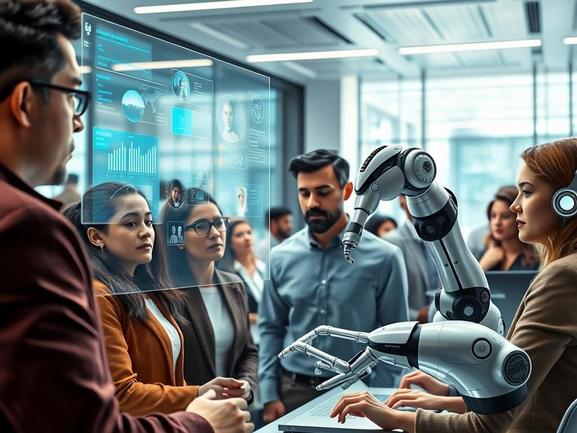
The relentless march of artificial intelligence is not just a technological shift; it’s a fundamental reshaping of the global economy and, more specifically, the very fabric of the workforce. We stand on the precipice of an era where intelligent machines are no longer confined to science fiction but are actively integrating into our daily professional lives, automating tasks once considered exclusively human domains. This rapid evolution sparks both excitement about unprecedented efficiency and innovation, alongside considerable anxiety regarding job security and the future landscape of employment. Understanding the profound implications of this AI-driven revolution is paramount for individuals, corporations, and governments alike, as we navigate towards a future where the relationship between humans and work is being redefined at an astonishing pace.
One of the most immediate and pressing concerns emanating from the rise of AI is the potential for widespread job displacement. While historically automation has often led to the creation of new types of jobs, the speed and scope of AI’s current capabilities suggest a potentially more disruptive transition. Experts are flagging particular vulnerability for entry-level white-collar positions, estimating that a significant majority—perhaps up to 70%—could face automation. This isn’t limited to manufacturing floors; sectors like finance, law, consulting, and administrative services are already seeing core tasks being handled by algorithms. The projected outcome? A potential increase in unemployment rates, possibly climbing by 10-20%, creating a significant “experience gap” where younger workers find fewer traditional entry points into their chosen fields. Jobs involving administrative functions, clerical duties, and routine physical tasks appear particularly susceptible, necessitating a serious re-evaluation of career pathways.
Corporate strategies are undeniably accelerating this shift. Many organizations are aggressively pursuing “AI-first” mandates, viewing automation not merely as an option but as a strategic imperative to slash operational costs and dramatically boost efficiency. This prioritization of AI is transforming industries, pushing companies to integrate intelligent systems into core business processes. However, this drive for efficiency comes with significant societal baggage. Beyond job losses, the economic consequences include a potential widening of income inequality, as the benefits of automation disproportionately accrue to capital owners and highly skilled AI specialists. Furthermore, the psychological toll on the workforce is tangible, manifesting as increased stress and anxiety about job security and the need for constant adaptation. The pressure to remain relevant in an ever-changing job market adds layers of mental burden for workers across various sectors.
Addressing these multifaceted challenges requires proactive and collaborative solutions. A cornerstone of mitigating job displacement is a robust emphasis on reskilling and upskilling the existing workforce. This involves not just learning new technical skills related to AI and automation, but also cultivating uniquely human capabilities such as critical thinking, creativity, emotional intelligence, and complex problem-solving—skills less likely to be replicated by machines in the near term. Educational institutions and corporate training programs must adapt rapidly to equip individuals with the competencies needed for the jobs of tomorrow. Furthermore, social safety nets and policy frameworks need to be re-evaluated to support displaced workers during transitions, perhaps exploring ideas like universal basic income or stronger unemployment benefits coupled with training programs. It is imperative that society invests heavily in human capital development to bridge the emerging gap between the skills people possess and the skills the future economy demands.
In conclusion, the AI workforce revolution is not a distant future; it is unfolding right now. While the potential for increased productivity and innovation is immense, the challenges related to job displacement, economic inequality, and psychological well-being are equally significant. Navigating this complex transition successfully requires a collective effort: corporations must consider the societal impact of their automation strategies, governments must implement forward-thinking policies to support workers and education, and individuals must embrace a mindset of lifelong learning and adaptability. The future of work is not a predetermined outcome; it is a future we are actively building. By understanding the challenges and committing to proactive adaptation and ethical integration of AI, we can strive towards a future workforce that leverages the power of artificial intelligence while ensuring prosperity and opportunity for a broader segment of humanity. The time to prepare for this revolution is now.