
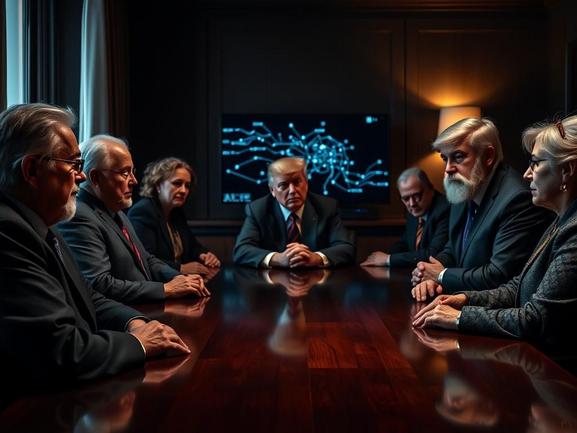
In an era increasingly defined by rapid technological advancement, where lines of code and artificial intelligence reshape our world at breakneck speed, unexpected voices are joining the conversation. Traditionally, discussions about AI policy and development have been confined primarily to tech industry boardrooms, government committees focused on national security and economic competitiveness, and academic research labs. However, recent developments highlight a growing engagement from another significant sector of society: faith leaders. The news that a group of prominent pastors and Christian leaders have weighed in on the topic, specifically addressing former President Donald Trump regarding his administration’s approach to AI, underscores the profound ethical and societal questions this technology raises, questions that resonate deeply within faith traditions.
While acknowledging the importance of the United States staying competitive in the global “AI race,” particularly referencing initiatives like the executive order aimed at boosting AI education, these faith leaders expressed a crucial caveat. Their message, delivered through a signed letter spearheaded by figures such as Rev. Johnnie Moore and Rev. Samuel Rodriguez, wasn’t merely one of technological boosterism. Instead, it was heavily seasoned with caution and a stark warning about AI’s “potential peril.” Drawing parallels to concerns voiced by tech luminaries like Elon Musk, Bill Gates, and Sam Altman, they highlighted the significant risks, ranging from widespread job displacement across various industries to the more abstract, yet deeply concerning, possibility of future human suffering. Their perspective introduces a moral dimension often overlooked in purely economic or geopolitical analyses of AI.
This engagement by faith leaders is not happening in a vacuum. It echoes sentiments recently articulated by Pope Leo XIV, who provocatively compared the current wave of AI advancements to the seismic societal shifts brought about by the Industrial Revolution. The Pope’s call for the Catholic Church to actively confront the challenges AI poses to fundamental aspects of human existence—our dignity, the nature of labor, and the fabric of society itself—provides a powerful theological and ethical framework for understanding why faith communities feel compelled to address this issue. Faith traditions have long grappled with how humanity integrates new powers and knowledge into existing moral and spiritual landscapes. As AI pushes the boundaries of what machines can do, questions about human uniqueness, creativity, purpose, and the inherent value of each individual come sharply into focus. These are not merely technical questions; they are deeply philosophical and theological ones.
Navigating the Ethical Maze
The faith leaders’ appeal to Trump was particularly insightful in its request for establishing mechanisms—an advisory council or delegated authority—that would prioritize not just the capabilities of AI but its ethical implications. They urged leaders to pay attention “especially not only to what AI CAN do but also what it SHOULD do.” This simple distinction is profoundly important. It moves the conversation beyond mere innovation and efficiency to consider the values, principles, and potential harms embedded in algorithmic decision-making and autonomous systems. What kind of future are we building with AI? Is it one that enhances human flourishing and dignity, or one that exacerbates inequality, erodes privacy, or diminishes the value of human work? Addressing what AI *should* do requires ethical discernment, a process where faith-based ethics, with their emphasis on justice, compassion, and the common good, have significant contributions to make.
“The moral imperative extends beyond merely winning a technological race; it lies in ensuring that the race is run with a clear vision for human well-being and dignity at the finish line.”
The engagement of faith leaders on the issue of AI signals a critical expansion of the stakeholders involved in shaping the future of technology. It suggests that discussions about AI cannot remain solely within the domain of technologists or policymakers focused narrowly on economic or security gains. Faith communities represent vast networks of people with diverse experiences and values, and their perspectives on human nature, ethics, and societal well-being are invaluable. Their involvement can help ground the often-abstract discussions about AI in real-world human concerns and timeless moral principles. It highlights the need for a multi-disciplinary, multi-stakeholder approach to AI governance that includes not just industry and government, but also civil society, ethicists, philosophers, and faith leaders.
In conclusion, the dialogue initiated by these faith leaders with President Trump regarding AI is a timely reminder that the development and deployment of powerful technologies like artificial intelligence are not just technical or economic challenges, but deeply moral and spiritual ones. Their message—a blend of acknowledging progress while issuing stern warnings about potential dangers and advocating for ethical guardrails—underscores the complex path humanity must navigate. As we stand at the precipice of an AI-transformed future, incorporating diverse ethical frameworks, including those offered by faith traditions, is not merely advisable; it is essential to ensure that artificial intelligence serves humanity’s highest aspirations rather than unleashing its greatest fears. The ultimate goal is not just smarter machines, but a wiser, more humane society forged in collaboration across all sectors.