
Google I/O always serves as a pivotal moment, offering a glimpse into the company’s strategic direction and technological aspirations. The 2025 edition certainly upheld this tradition, painting a vivid picture of a future deeply integrated with artificial intelligence. From significant leaps in their flagship AI models to explorations in novel hardware interfaces, the announcements underscored a persistent drive towards making technology more intuitive, powerful, and, arguably, pervasive in our daily lives. This event wasn’t just about showcasing new features; it was a declaration of intent, signaling Google’s commitment to leading the charge in the ongoing AI revolution and redefining how we interact with information, create content, and connect with others. If you blinked, you might have missed some key takeaways, but fear not – let’s unpack the most significant developments that hint at where Google sees our digital (and soon, physical) world heading.
Central to the I/O narrative was the continued evolution of the Gemini family. The spotlight shone brightly on Gemini 2.5, heralded as a more refined and potent iteration. We heard about enhancements spanning fundamental capabilities – reasoning became sharper, multimodality more fluid, and even the underlying efficiency improved, requiring fewer computational resources for equivalent or better performance. This isn’t merely incremental progress; it speaks to the rapid pace at which these models are learning and optimizing. The vision articulated suggests Gemini isn’t just a tool for specific tasks but is morphing into what could genuinely be described as a “universal AI assistant”. This implies a far deeper integration into the user experience, proactively helping across various applications and contexts. Of course, pushing the boundaries often comes with considerations of access and cost. The mention of
Google AI Ultra
as a potential subscription tier raises interesting questions about how these advanced capabilities will be tiered and made available, potentially creating a divide between free and premium AI experiences. Will the value proposition of “Ultra” justify the expense for the average user or is it primarily targeted at power users and businesses? Only time will tell how this pricing model impacts the accessibility of Google’s most advanced AI.
Beyond the core model enhancements, Google unveiled a suite of tools aimed squarely at the creative community and fundamentally altering the search paradigm. The introduction of
- Veo (video generation)
- Imagen (image generation)
- Flow (interactive media?)
signals Google’s intent to empower users with sophisticated AI-powered generation capabilities. These tools could democratize content creation, enabling individuals and small teams to produce high-quality assets previously requiring significant resources or expertise. Simultaneously, the very act of “searching” is undergoing a radical transformation. The integration of Project Astra’s multimodal abilities means search is no longer confined to text queries. Imagine simply pointing your phone’s camera at an unfamiliar plant or a complex diagram and instantly getting detailed information. This visually driven search, combined with the specialized “AI Mode” for shopping that offers style suggestions and virtual try-ons, moves search from being an information retrieval task to a highly interactive and personalized discovery experience.
“Searching on Google will no longer be the same,” quipped one observer, and based on these announcements, they might be right.
These developments suggest a future where getting answers or finding products is seamlessly integrated with our physical environment and personal preferences.
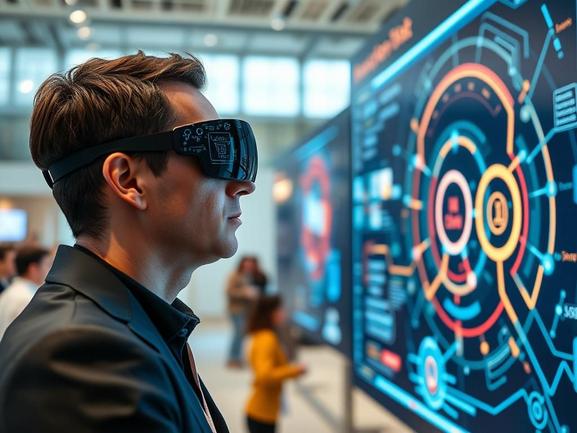
Google I/O 2025 also highlighted advancements in productivity tools and a glimpse into future hardware interfaces. The promised enhancements to Gmail via AI integration aim to streamline workflows, potentially handling routine tasks, summarizing long threads, or even drafting responses, freeing up users to focus on more complex communication. This aligns with the broader theme of AI acting as a ubiquitous assistant. On the hardware front, the evolution of Project Starline into “Google Beam” indicates continued progress on immersive communication technologies. While the exact details often remain somewhat veiled for such projects, the core idea of feeling more physically present in virtual interactions holds significant promise for remote work and personal connections. Perhaps even more forward-looking was the sneak peek at Android XR on smart glasses. This signals Google’s serious commitment to the extended reality space, positioning Android as the potential operating system for future wearable displays. Combining a mature OS with specialized hardware could accelerate the development of practical and compelling AR/VR applications, potentially bringing context-aware computing and spatial interfaces into the mainstream within the coming years.
Reflecting on the breadth of announcements from Google I/O 2025, a clear picture emerges: Google is betting heavily on AI as the driving force for the next generation of computing. From refining the foundational models like Gemini to weaving AI into ubiquitous services like Search and Gmail, the strategy is multifaceted. The introduction of advanced creative tools and the continued pursuit of immersive technologies like Google Beam and Android XR on smart glasses demonstrate an ambition to not only enhance existing digital interactions but to forge entirely new ones. However, with this rapid advancement come inherent questions about privacy, ethical AI development, and ensuring equitable access to these powerful tools. As AI becomes increasingly capable and integrated, the discussions around its societal impact become ever more critical. Google I/O 2025 presented a compelling vision of an AI-enhanced future, but the true measure of its success will lie not just in the technology itself, but in how responsibly and inclusively it is deployed and governed, shaping a future that benefits everyone. The age of pervasive AI is not just coming; it’s already knocking, and Google just opened the door wider.