
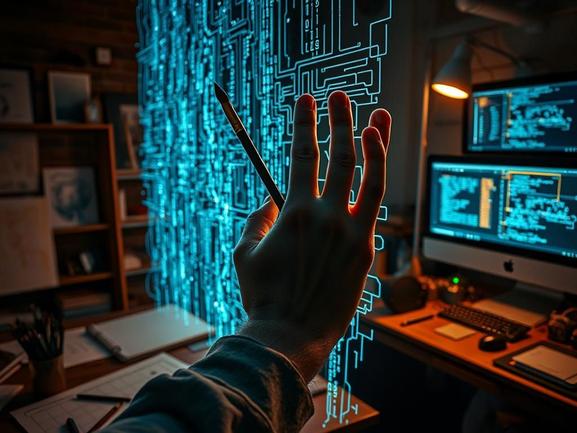
As the algorithms advance and capabilities expand at a breathtaking pace, the integration of Artificial Intelligence into various facets of industry is no longer a futuristic concept; it is a present-day reality. While often heralded for its potential to boost efficiency, streamline processes, and unlock new frontiers of innovation, the rapid deployment of AI also casts a long, unsettling shadow over the human workforce. The narrative of automation replacing manual labour is a familiar one from previous industrial revolutions, but the current wave, driven by sophisticated generative AI, presents a unique challenge – it is encroaching upon domains once thought uniquely human: creativity, artistry, and nuanced expression. This shift is sparking significant anxiety, leading to difficult conversations about job security, the intrinsic value of human skill, and the ethical boundaries of artificial intelligence. The frictionless efficiency promised by AI is revealing an often-overlooked cost: the potential displacement and devaluation of the very human talent that gives work its soul and connection.
Across sectors where imagination and personal touch were paramount, the ground is beginning to shift dramatically. Consider fields like graphic design, illustration, writing, and voice acting – professions built on years of honed skill, individual style, and the ability to infuse work with emotion and personality. Generative AI tools can now produce visual assets, draft text, and even replicate vocal tones with startling accuracy, and crucially, at speeds and costs that often undercut human professionals. The allure for businesses is clear: Increased speed, reduced expenditure, and scalable output. However, for the individuals whose livelihoods depend on these creative outputs, the reality is stark. Many are finding their roles diminishing or disappearing entirely, replaced by lines of code and computational power. The experience of dedicating years to mastering a craft, only to see a machine replicate aspects of it near-instantly, raises profound questions about career paths, the future of creative education, and the societal value placed on human artistic endeavor in the face of algorithmic efficiency.
Beyond the immediate economic impact, the rise of generative AI introduces complex ethical dilemmas and questions about the intrinsic value of human-created work. One deeply concerning aspect highlighted by recent events is the use of individuals’ unique characteristics, such as their voice, without explicit consent or fair compensation. The ease with which AI can clone and deploy a voice, for example, for purposes the original artist never agreed to, underscores a critical need for robust legal and ethical frameworks. Furthermore, there is a palpable sense among some that AI-generated creative work, while technically proficient, often lacks the depth, authenticity, and human experience that resonates with audiences on an emotional level. A piece of writing might be grammatically perfect, an image aesthetically pleasing, or a voice performance technically accurate, but do they carry the subtle nuances, the lived experience, or the passion that a human creator imbues? Many argue that this human element is what truly connects with others, fosters relatability, and drives genuine engagement – qualities that purely factual or technically correct AI output may struggle to replicate.
The disruptive potential of generative AI extends far beyond individual job roles; it has broader implications for the economy, society, and future generations. There is a legitimate fear that as AI becomes more capable across a wider range of tasks, the demand for human labour, particularly in roles that require creativity and critical thinking, could shrink significantly. This presents a daunting challenge for young people entering the workforce, who may find traditional creative paths increasingly precarious.
Navigating this transition requires a multi-faceted approach:
- Investing in education and training that focuses on skills AI cannot easily replicate, such as complex problem-solving, emotional intelligence, and interdisciplinary collaboration.
- Developing policies and regulations that protect artists’ rights, ensure transparency in the use of AI-generated content, and address issues of ownership and compensation.
- Encouraging a societal dialogue about the purpose of work, the balance between efficiency and human value, and how we can collectively adapt to a future where humans and AI coexist and potentially collaborate in new ways.
The challenge is not simply about adapting to new tools, but fundamentally rethinking the relationship between humanity and technology in the realm of creative and intellectual work.
In conclusion, the rapid proliferation of generative AI is undeniably reshaping the professional landscape, particularly within creative industries. While offering significant potential for efficiency and innovation, its deployment raises critical concerns regarding job displacement, the ethical use of personal attributes, and the potential erosion of the human touch in creative output. The anecdotes emerging from those directly impacted serve as a crucial reminder that behind the algorithms and code lie human lives, skills, and aspirations facing unprecedented disruption. As we move forward, the imperative is clear: we must foster a future where AI serves as a powerful amplifier of human creativity and capability, rather than solely a replacement. This requires thoughtful technological development, proactive policy-making, and a collective commitment to valuing and preserving the unique contributions that only human artistry and ingenuity can provide in an increasingly automated world. The conversation about the cost of code is far from over; it has just begun.