
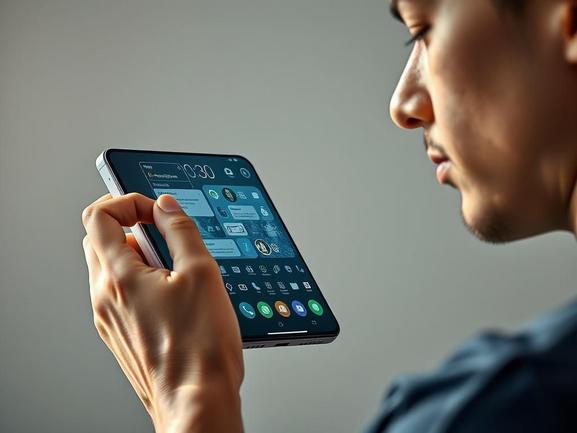
For years, our smartphones have been defined by a grid of icons, each representing a distinct application designed for a specific purpose. We tap, swipe, and switch between dozens, sometimes hundreds, of these self-contained digital environments daily. This paradigm, while incredibly powerful and versatile, has also introduced complexity, fragmentation, and a constant demand on our attention as we navigate disparate interfaces and data silos. Enter a bold, almost futuristic vision: a smartphone experience where the operating system itself becomes the singular, all-encompassing interface, intuitively anticipating needs and executing tasks without the need to launch individual programs. This radical concept, recently voiced by a prominent figure in the mobile industry, challenges the very foundation of how we interact with our most personal computing devices, proposing a future deeply intertwined with advanced artificial intelligence.
The current mobile landscape, dominated by established players and their vast app ecosystems, feels both mature and, perhaps, somewhat stagnant in its fundamental interaction model. While devices become faster and screens sharper, the core act of finding, opening, and using separate applications remains largely unchanged. This reality forms the backdrop for the provocative assertion that the established leaders might be lagging in truly revolutionary thinking. The proposed alternative paints a picture of unprecedented simplicity and efficiency. Imagine a device that understands your context – where you are, who you’re with, what you’re doing next – and proactively surfaces the necessary information or takes action, blending functionalities that currently reside in separate apps into a seamless flow. This isn’t just about better recommendations; it’s about the OS acting as an intelligent agent, capable of composing actions from underlying services, eliminating the need for the user to manually open, say, a maps app, a messaging app, and a calendar app in sequence for a simple task like coordinating meeting logistics.
At the heart of this transformative vision lies the exponential advancement of generative AI and machine learning. The argument is compelling: as AI models become more sophisticated, capable of understanding complex natural language, processing context from various sensors and data points, and even predicting user intent, they can effectively take over functions previously siloed within dedicated applications. Consider tasks like booking a dinner reservation, finding information, managing communications, or planning a trip. Today, these require navigating multiple apps – a browser, a review site, a booking platform, a messaging app. In an AI-centric OS future, a single natural language request or even a recognized contextual cue could trigger the OS to handle the entire workflow, leveraging its deep understanding of the user and access to necessary data streams (with appropriate permissions, of course). This shift suggests a move from a command-and-control interface, where the user explicitly tells an app what to do, to a more collaborative partnership, where the OS anticipates and assists, much like an incredibly capable personal assistant embedded directly into the device’s core.
However, the path to such a unified, AI-driven OS is fraught with significant technical, conceptual, and societal challenges, making the projected timeline of 7-10 years feel perhaps even optimistic.
Technical Hurdles:
- AI Capability: The AI needs to be robust, reliable, and capable of understanding nuanced, real-world contexts, far beyond current capabilities.
- Data Integration & Privacy: A unified OS requires access to a vast amount of personal data from various domains (location, communication, health, finance, etc.). Managing this data securely and ensuring user privacy and control is paramount and incredibly complex.
- Developer Ecosystem Transition: The current mobile economy is built on individual apps. Shifting to a service-based, OS-driven model requires a complete re-architecture of how software is developed, distributed, and monetized.
- System Reliability: If the entire phone relies on one intelligent OS, any error or misunderstanding by the AI could render the device frustrating or even unusable.
Furthermore, user adoption presents its own set of hurdles. People are deeply ingrained in current app-based workflows. Educating users and building trust in an OS that makes decisions and takes actions autonomously will be a monumental task. The radical nature of the concept means it won’t be an easy sell initially.
Despite the challenges, the core idea of an intelligent layer simplifying smartphone interaction resonates with a growing frustration with the current app-centric model. While a single, monolithic “OS app” might be an extreme endpoint, the trend towards deeper OS integration, cross-app functionality, and AI-powered assistance is already visible. Features like universal search, intelligent suggestions (e.g., proposing actions based on messages), and more powerful widgets hint at this direction. The future might not be a strict “one app,” but rather a highly intelligent, context-aware operating system that abstracts away the need to manually launch and manage separate applications for most tasks. Apps might still exist for specialized, deep-dive functions or creative tools, but the default interaction for everyday needs could shift to an AI-mediated dialogue with the OS itself. This evolution poses fascinating questions for the entire tech industry, from hardware manufacturers and OS developers to app developers and content creators.
“The system knows you, knows who you are, and knows what you want. For example, the system knows your situation, time, place, and schedule, and it suggests what you should do.” – Paraphrased core concept.
In conclusion, the notion of a single, intelligent OS replacing the familiar grid of apps is a truly revolutionary concept that forces us to reconsider our fundamental relationship with smartphones. While the technical and practical barriers are immense, the underlying principle – leveraging AI to create a more seamless, intuitive, and context-aware computing experience – addresses real pain points in the current model. Whether it manifests as a literal “one app” or a highly intelligent, integrated OS layer, the drive towards personalization, automation, and abstraction of underlying services seems an inevitable trajectory fueled by AI advancements. This future promises increased efficiency and simplicity, but also raises critical questions about data privacy, user agency, and the very nature of the digital interfaces that mediate so much of our lives. The next decade in smartphone evolution promises to be less about incremental hardware upgrades and more about a profound rethinking of the software soul of these indispensable devices.